

'/%3E%3C/svg%3E)
No products in the cart.

Iranian raisins are widely recognized for their excellent quality | Why are Iranian raisins popular in international markets?
Introduction
Iran has long been recognized as one of the world’s leading producers of high-quality raisins. With its favorable climate, fertile soil, abundant sunshine, and centuries of grape-growing tradition, the country produces a wide variety of premium raisins that are exported to markets across Europe, Asia, the Middle East, and beyond.
Among dried fruits, Iranian raisins have earned an outstanding reputation for their natural sweetness, attractive appearance, rich nutritional value, and competitive pricing. Whether used as a healthy snack, a baking ingredient, or a raw material for the food industry, raisins from Iran consistently meet the expectations of international buyers looking for reliable quality and stable supply.
For detailed nutritional information about dried fruits, readers can also refer to FoodData Central.

Today, Iran ranks among the world’s largest raisin-producing countries, supplying a significant share of the global market. Modern processing facilities, advanced sorting technologies, strict quality control procedures, and flexible packaging solutions have enabled Iranian exporters to serve wholesalers, distributors, retailers, and food manufacturers in more than 80 countries.
One of the greatest advantages of Iranian raisins is the remarkable diversity of products available. Depending on the grape variety, drying method, and processing technique, Iran produces several popular raisin types, including:
- Golden Raisins
- Sultana Raisins
- Sun-Dried Raisins
- Green Raisins
- Black Raisins
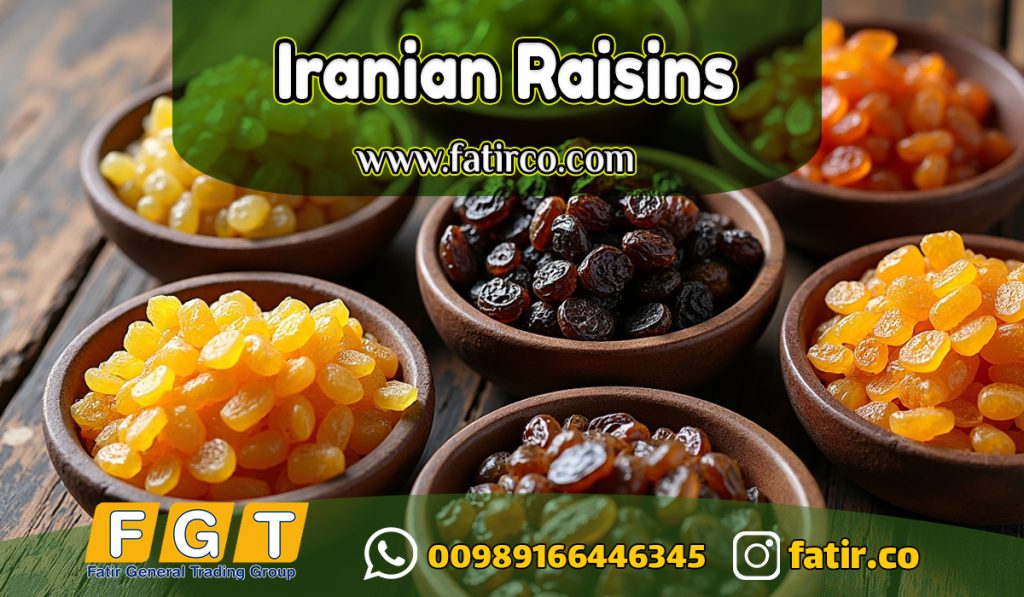
Each variety offers unique characteristics in terms of color, texture, flavor, moisture content, and intended applications. This diversity allows international buyers to select products that perfectly match the requirements of different industries, including bakery, confectionery, breakfast cereals, dairy products, chocolate manufacturing, and snack production.
In addition to product diversity, Iranian raisin manufacturers have continuously invested in food safety and quality assurance. Many export-oriented facilities operate under internationally recognized standards such as HACCP, ISO 22000, BRCGS, and other food safety management systems to ensure that every shipment meets the specifications required by global markets. Advanced laser sorting, metal detection, optical color sorting, washing, cleaning, and hygienic packaging further enhance product quality and consistency.
Another important factor behind the success of Iranian raisins is their excellent balance between quality and price. Thanks to favorable agricultural conditions and large-scale grape cultivation, Iranian suppliers can offer premium export-quality raisins at highly competitive prices compared with many other producing countries. This cost advantage has made Iran a preferred sourcing destination for importers seeking reliable long-term partnerships.
Nutritionally, raisins are considered one of nature’s healthiest dried fruits. They are naturally rich in dietary fiber, potassium, iron, antioxidants, and beneficial plant compounds while containing no added sugar in their natural form. As consumers increasingly demand healthier snacks and clean-label food ingredients, Iranian raisins continue to gain popularity among health-conscious buyers worldwide.
Beyond their nutritional benefits, raisins are also appreciated for their versatility. They can be enjoyed directly as a convenient snack or incorporated into countless recipes, including breads, cakes, cookies, cereals, salads, rice dishes, desserts, and traditional cuisines from different regions of the world. Their naturally sweet flavor also makes them an attractive ingredient for reducing refined sugar in many food formulations.
For international importers, choosing the right supplier is just as important as selecting the right product. Reliable Iranian exporters combine decades of production experience with efficient logistics, customized packaging, and responsive customer service to meet the diverse needs of global buyers. From bulk industrial packaging to retail-ready private label solutions, Iranian raisin suppliers offer flexible options suitable for businesses of all sizes.
This comprehensive guide explores everything you need to know about Iranian raisins, including their varieties, production process, nutritional value, quality standards, packaging options, export capabilities, and the reasons why they remain one of the most trusted dried fruit products in international trade. Whether you are an importer, wholesaler, food manufacturer, or simply interested in learning more about premium raisins from Iran, this article provides valuable insights to help you make informed decisions.

Why Iranian Raisins Are Famous Worldwide
For centuries, Iran has been recognized as one of the world’s most important grape-growing regions. Thanks to its diverse climate, fertile agricultural land, abundant sunshine, and generations of farming expertise, the country has become a trusted producer of premium-quality raisins that are exported to customers around the globe.
Today, Iranian raisins are valued not only for their excellent taste but also for their consistent quality, competitive pricing, and wide variety of products. These advantages have helped Iranian exporters establish long-term partnerships with food manufacturers, wholesalers, retailers, and importers in many international markets.
Ideal Climate for Premium Grapes
One of the main reasons behind the exceptional quality of Iranian raisins is the country’s unique climate. Many grape-growing regions enjoy hot, dry summers combined with cool nights during the ripening season. These natural conditions allow grapes to develop higher sugar content while maintaining their characteristic flavor and texture.
Low humidity during harvest also reduces the risk of fungal diseases and helps produce healthier grapes that are ideal for raisin production. In many vineyards, the grapes ripen naturally under abundant sunshine, resulting in raisins with rich sweetness, attractive color, and excellent shelf life.
A Long Tradition of Grape Cultivation
Iran has cultivated grapes for thousands of years, making viticulture an important part of its agricultural heritage. Over generations, growers have refined cultivation methods, harvesting techniques, and drying processes to produce raisins that meet the expectations of both domestic and international markets.
This experience has enabled Iranian producers to combine traditional knowledge with modern food-processing technologies, creating products that satisfy today’s global quality standards.
Wide Variety of Raisins
Another major strength of Iran’s raisin industry is the diversity of products available. Different grape varieties, drying methods, and processing techniques produce raisins suitable for various applications across the food industry.
International buyers can source products such as:
- Golden Raisins
- Sultana Raisins
- Sun-Dried Raisins
- Green Raisins
- Black Raisins
Each variety has its own appearance, flavor profile, moisture level, and recommended use, allowing buyers to select products that best fit their target market.
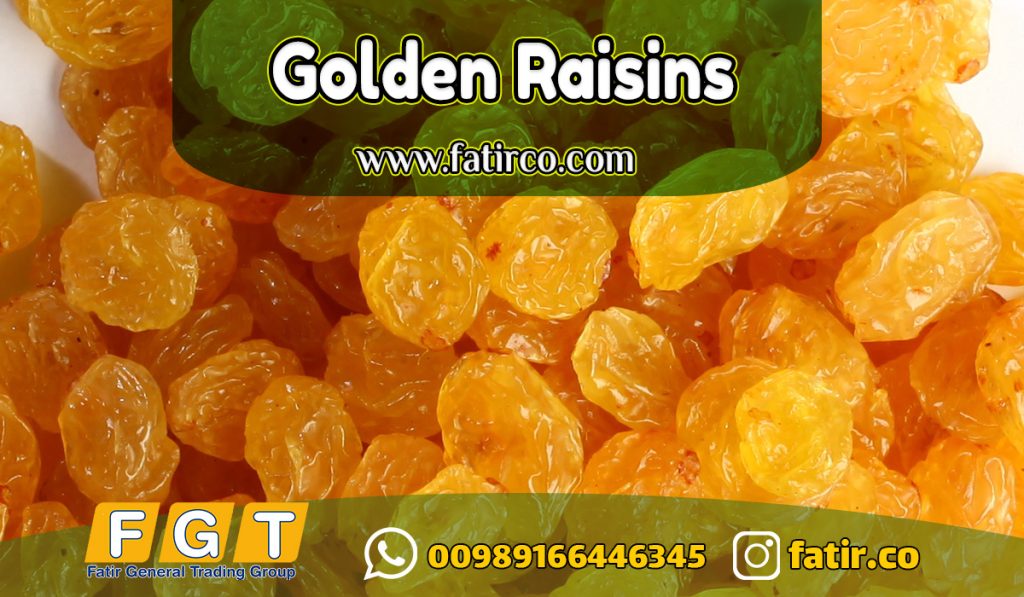
For example, Golden Raisins are especially popular in bakery products, cereals, and premium snack mixes due to their bright color and mild sweetness, while naturally sun-dried raisins are widely used in confectionery, traditional foods, and industrial food production.
Competitive Prices Without Compromising Quality
One of the biggest advantages of sourcing raisins from Iran is the balance between affordability and quality.
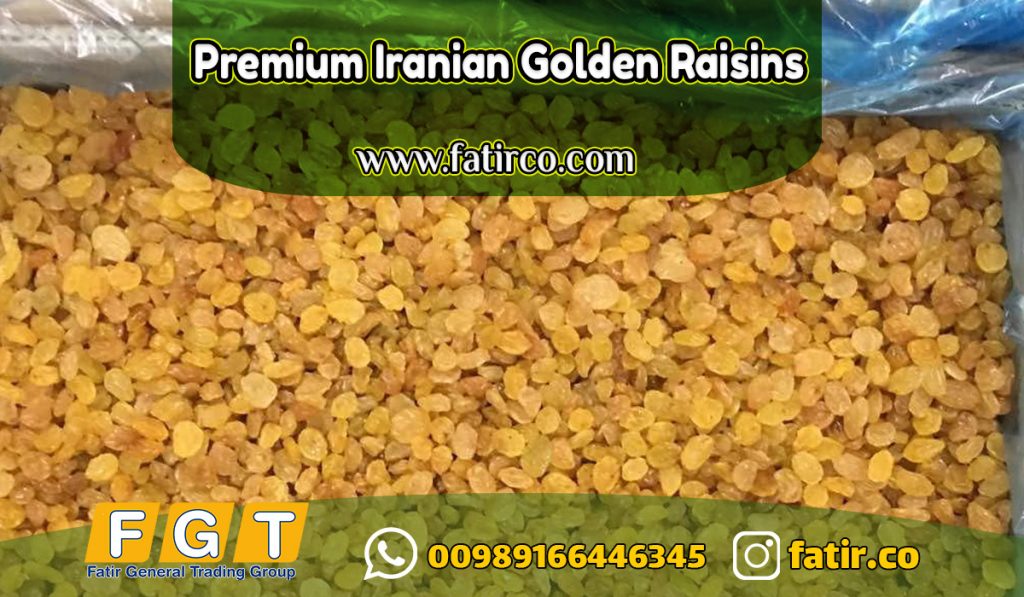
Large-scale grape cultivation, favorable weather conditions, and efficient production systems enable Iranian suppliers to offer export-quality raisins at competitive prices. This makes Iran an attractive sourcing destination for companies looking to optimize procurement costs while maintaining high product standards.
For importers purchasing in bulk, this combination of quality and value can significantly improve profitability.
Modern Processing Facilities
The Iranian raisin industry has invested heavily in modern processing technologies to meet international market requirements.
Many export-oriented facilities are equipped with:
- Optical color sorting systems
- Laser sorting technology
- Metal detectors
- Multi-stage washing and cleaning lines
- Stem removal systems
- Moisture control equipment
- Hygienic packaging lines
These technologies help ensure uniform product quality, minimize foreign materials, and improve food safety before shipment.
Strict Quality Control
Quality assurance plays a critical role throughout the production process.
From vineyard management and harvesting to processing and packaging, every stage is monitored to maintain product consistency. Exporters carefully evaluate factors such as:
- Color uniformity
- Moisture content
- Size grading
- Sugar level
- Cleanliness
- Stem percentage
- Foreign material control
Many manufacturers also conduct laboratory testing before shipment to verify compliance with customer specifications and destination-country requirements.
Reliable Supply for International Buyers
Another reason why Iranian raisins are highly regarded is the country’s strong production capacity.
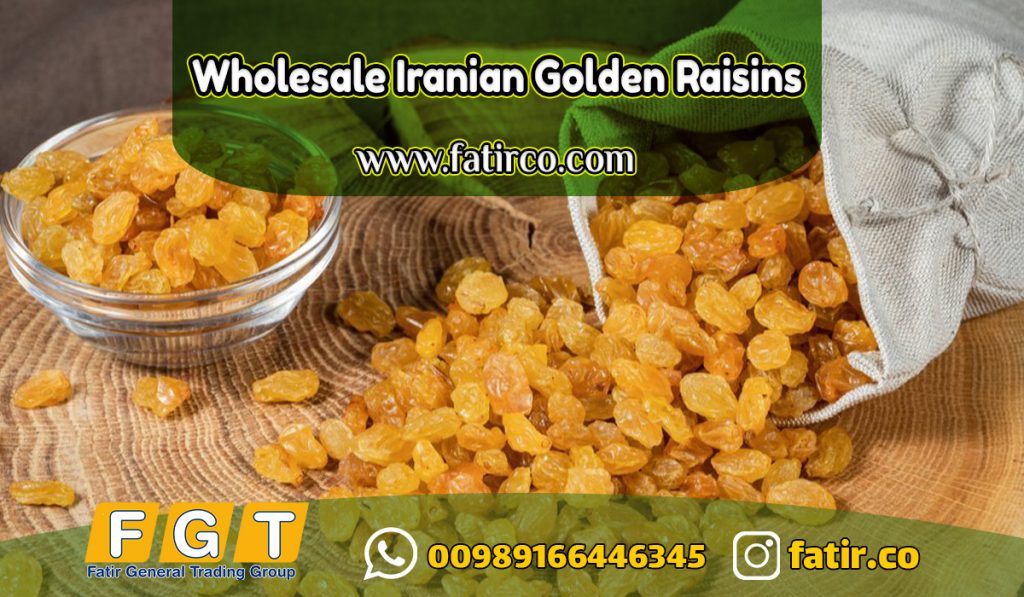
Extensive vineyards across multiple agricultural regions allow exporters to fulfill both small and large-volume orders throughout the year. Whether customers require container-load shipments or long-term supply contracts, many Iranian suppliers have the production capability and logistics experience to deliver efficiently.
This reliable supply chain has made Iranian raisins a preferred choice for food manufacturers, supermarket chains, wholesalers, and private-label brands worldwide.
An Excellent Choice for Global Markets
As consumer demand for healthy, natural foods continues to grow, raisins remain one of the most popular dried fruits worldwide.
Iranian raisins combine natural sweetness, nutritional value, attractive appearance, and competitive pricing, making them suitable for a wide range of international markets. Their versatility allows them to be used in bakery products, confectionery, dairy products, breakfast cereals, snack foods, and many traditional recipes across different cultures.
For businesses seeking a dependable source of premium dried fruit, Iranian raisins continue to stand out as a reliable and cost-effective solution.

Major Raisin-Producing Regions in Iran
Iran is one of the world’s leading producers of grapes and raisins, with vineyards spread across several provinces that offer ideal conditions for cultivating high-quality grapes. The country’s diverse climate, fertile soils, and long growing season allow different regions to produce raisins with distinctive characteristics in terms of color, sweetness, texture, and moisture content.
Each production area has developed its own expertise over generations, contributing to the wide variety of Iranian raisins available in international markets. This geographical diversity enables exporters to supply products that meet the preferences of buyers in different countries and industries.
Malayer – The Heart of Iran’s Raisin Industry
Located in western Iran, Malayer is widely recognized as one of the country’s most important raisin-producing regions. The area has earned an international reputation for cultivating premium seedless grapes that are processed into high-quality export raisins.
The region’s moderate climate, fertile land, and experienced growers make it an ideal location for producing raisins with uniform size, pleasant sweetness, and attractive color. Malayer is particularly known for manufacturing:
- Golden Raisins
- Sultana Raisins
- Sun-Dried Raisins
Many modern processing facilities are also located in and around Malayer, where raisins undergo cleaning, grading, color sorting, metal detection, and hygienic packaging before export.
Because of its strong infrastructure and production capacity, Malayer plays a significant role in supplying international markets throughout the year.
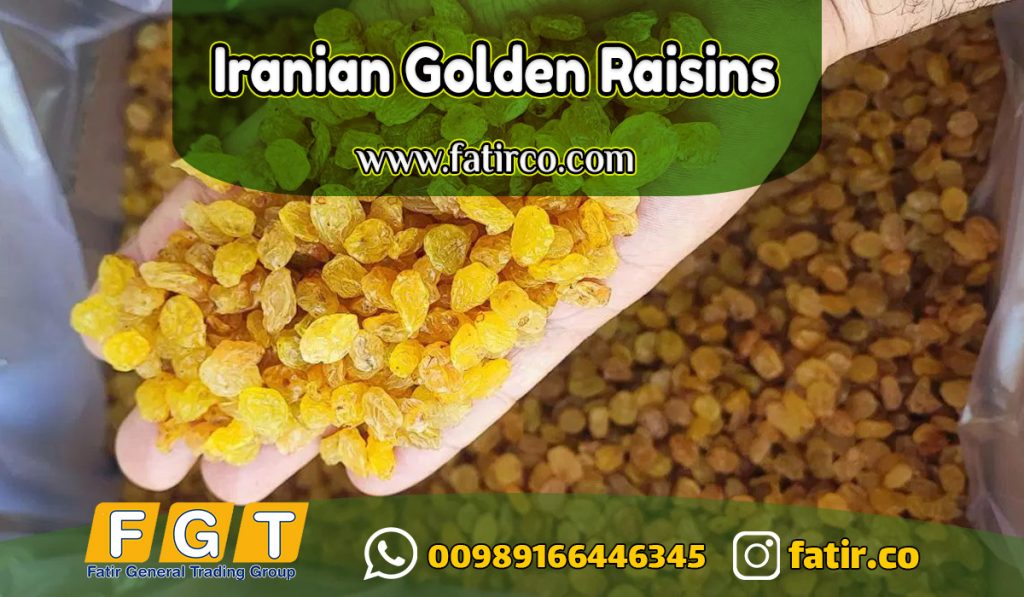
Takestan – One of Iran’s Largest Grape-Growing Areas
Takestan, situated in Qazvin Province, is another major center of grape cultivation. The region has thousands of hectares of vineyards and produces substantial quantities of grapes for both fresh consumption and raisin processing.
The combination of warm summers, adequate sunshine, and suitable irrigation systems allows grapes to reach excellent maturity before harvest.
Takestan is particularly valued for producing:
- Golden Raisins
- Green Raisins
- Natural Sun-Dried Raisins
Its production supports both domestic consumption and export markets, making it one of the pillars of Iran’s dried fruit industry.
Bonab – A Growing Export Hub
Bonab, located in East Azerbaijan Province, has become an increasingly important center for raisin production and processing.
The region benefits from favorable agricultural conditions and modern processing facilities that manufacture export-grade raisins for international customers.
Bonab producers focus on:
- Consistent product quality
- Hygienic processing
- Bulk packaging
- International food safety requirements
Many exporters source raisins from this region because of its reliable production capacity and competitive pricing.
Kashmar – Famous for Premium Green Raisins
Kashmar, in northeastern Iran, is internationally known for producing high-quality Green Raisins, one of the country’s most distinctive raisin varieties.
Unlike many other raisin types, Kashmar’s green raisins are appreciated for their elongated shape, natural green color, delicate sweetness, and soft texture.
These raisins are especially popular in:
- Middle Eastern markets
- South Asian countries
- Premium retail packaging
- Gourmet food stores
Their unique appearance makes them one of Iran’s most recognizable specialty products.
Other Important Raisin-Producing Areas
In addition to the major regions mentioned above, several other provinces contribute significantly to Iran’s raisin production.
These include vineyards located in:
- Zanjan
- Khorasan Razavi
- Fars
- West Azerbaijan
- East Azerbaijan
- Hamadan
Each region offers slightly different climatic conditions that influence grape quality, harvest timing, and the final characteristics of the raisins.
This geographical diversity enables Iranian exporters to supply a broad range of products suitable for different customer requirements.
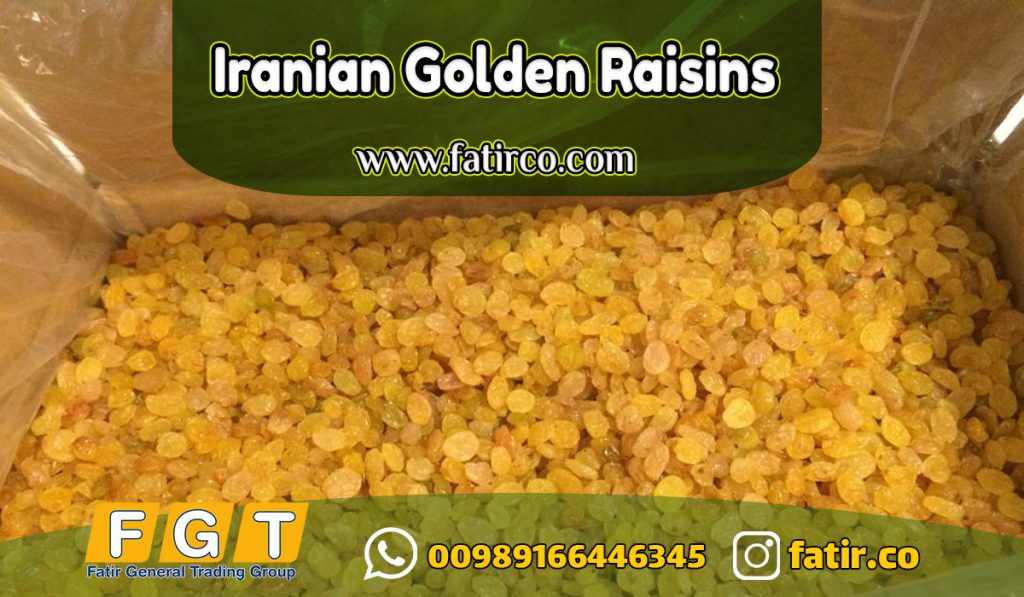
Favorable Natural Conditions
One of the reasons Iranian raisins maintain a strong reputation worldwide is the country’s naturally favorable agricultural environment.
Key advantages include:
- Long hours of sunshine during the growing season
- Low rainfall during harvest
- Fertile agricultural soils
- Significant temperature differences between day and night
- Traditional vineyard management combined with modern farming techniques
These conditions allow grapes to develop high natural sugar levels while preserving their flavor, aroma, and nutritional value.
Strong Supply Capacity
Because raisin production is distributed across several agricultural regions, Iran enjoys a stable and diversified supply chain.
This geographical distribution offers several advantages:
- Reduced dependence on a single production area
- More stable annual production volumes
- Greater flexibility in sourcing different raisin varieties
- Improved reliability for export customers
For international buyers, this means access to a consistent supply of high-quality raisins throughout the export season.
A Strategic Advantage for Global Buyers
The combination of experienced growers, favorable natural conditions, modern processing facilities, and regional specialization has made Iran one of the world’s most competitive raisin-producing countries.
Whether buyers are looking for premium Golden Raisins, naturally sun-dried raisins, specialty Green Raisins, or bulk industrial ingredients, Iran’s diverse production regions offer solutions that meet the quality, volume, and consistency required by global food markets.

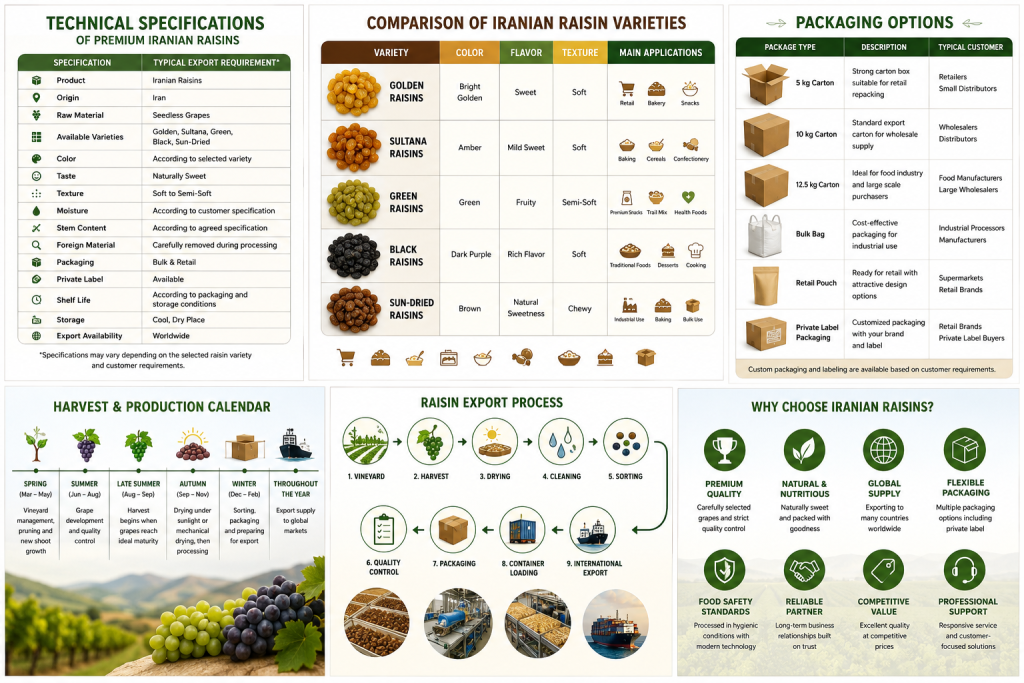
Types of Iranian Raisins
One of the greatest strengths of the Iranian raisin industry is its remarkable product diversity. Thanks to different grape varieties, drying methods, and processing techniques, Iran produces a wide selection of raisins that meet the needs of international food manufacturers, wholesalers, retailers, and private-label brands.
Each type of raisin has its own appearance, flavor, texture, moisture level, and intended application. Understanding these differences helps importers choose the most suitable product for their target market.
Below are the most popular varieties of Iranian raisins available for export.
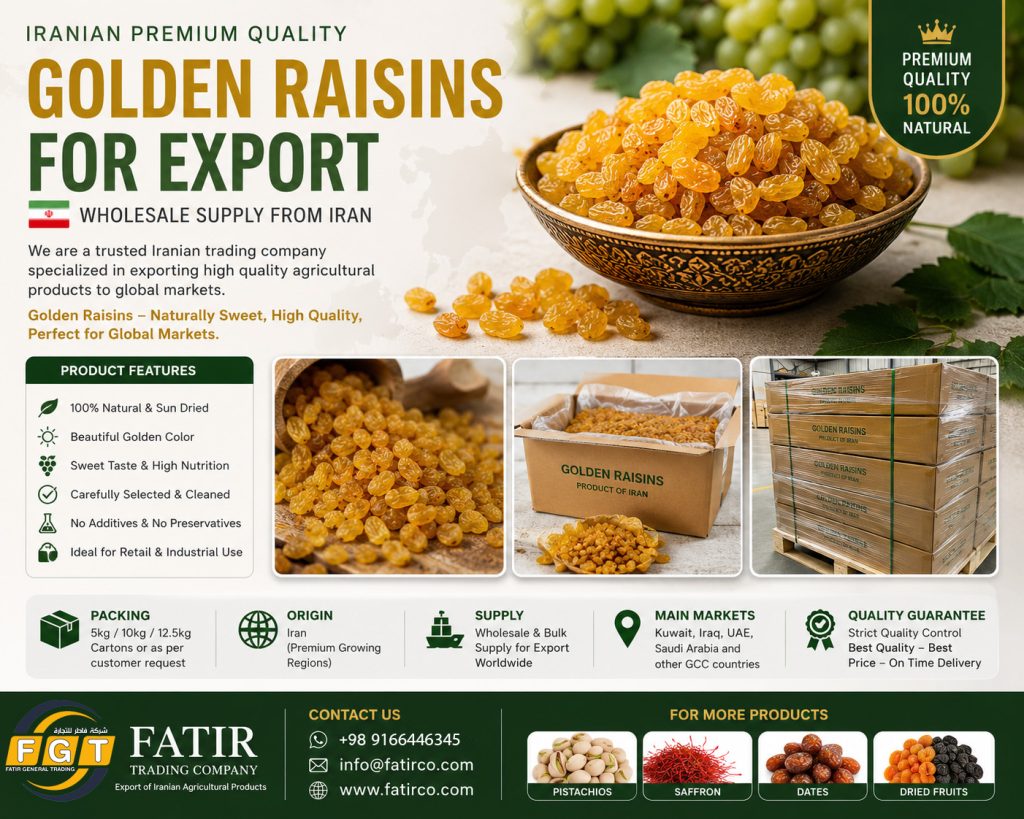
Golden Raisins
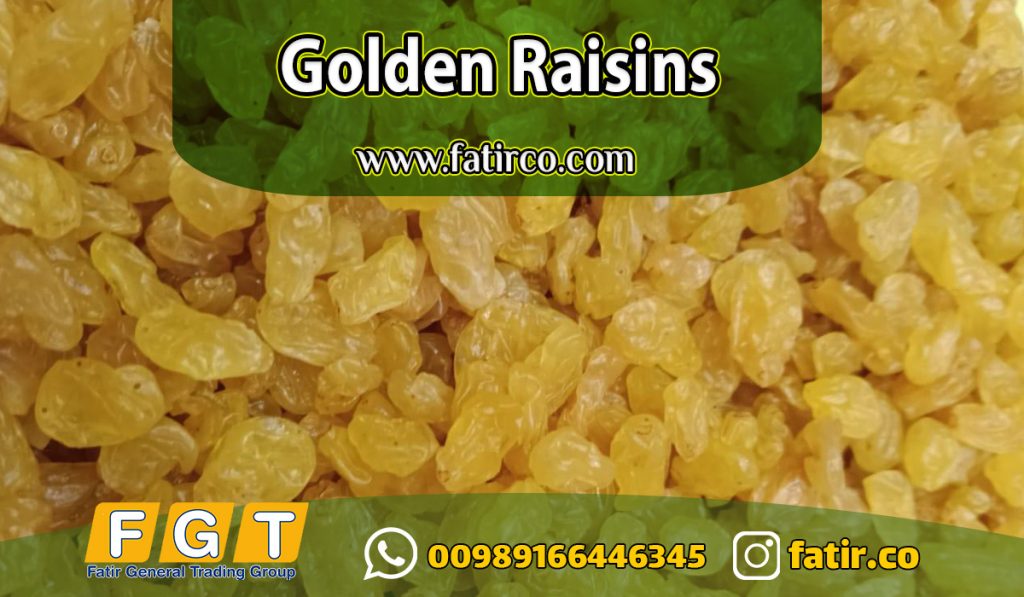
Golden Raisins are among the most popular export products of Iran. Their bright golden-yellow color, soft texture, and naturally sweet flavor make them highly attractive for international markets.
They are produced from premium seedless grapes that are carefully processed using controlled drying methods to preserve their appealing color and consistent quality. Export-grade golden raisins are typically cleaned, stemmed, laser sorted, metal detected, and packed under strict hygienic conditions before shipment.
Main Characteristics
- Bright golden color
- Soft and chewy texture
- Naturally sweet flavor
- Uniform size and appearance
- Long shelf life
- Excellent visual appeal
Common Applications
- Breakfast cereals
- Bakery products
- Cookies and biscuits
- Premium snack mixes
- Chocolate and confectionery
- Retail consumer packs
Golden raisins are especially popular in Europe, the Middle East, and many Asian countries due to their attractive appearance and premium quality.
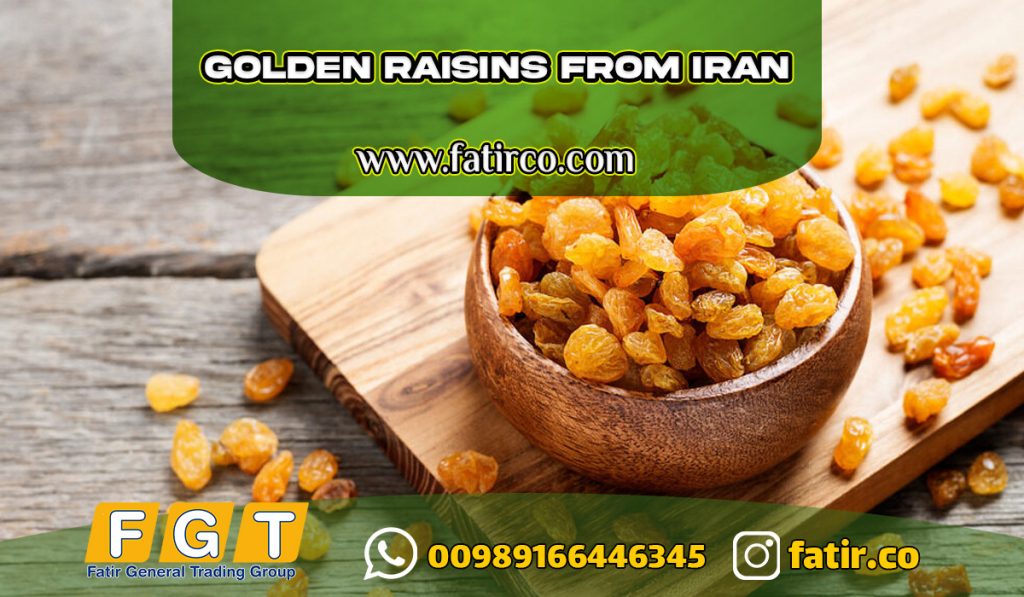
Sultana Raisins
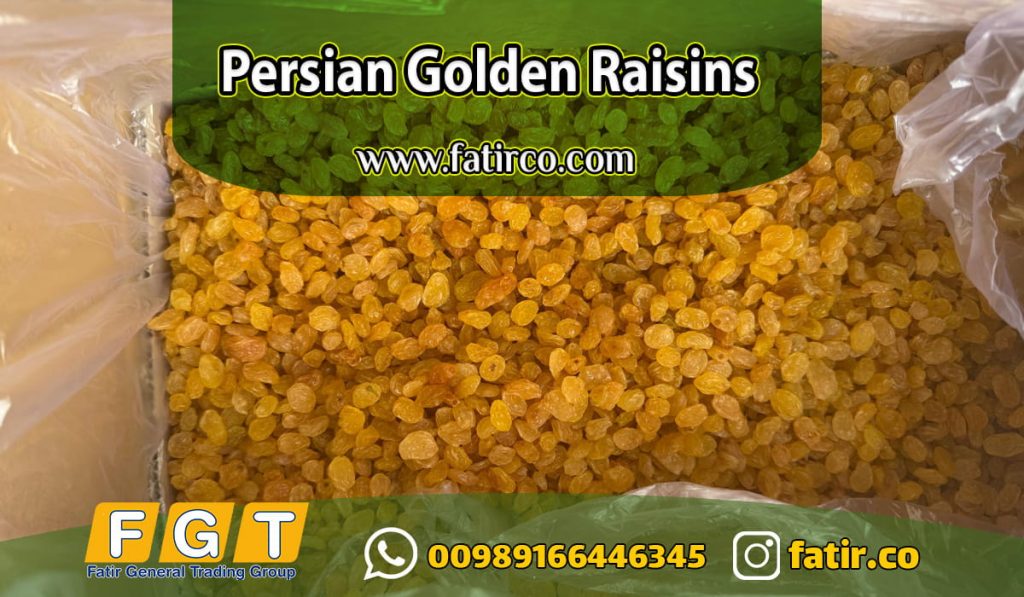
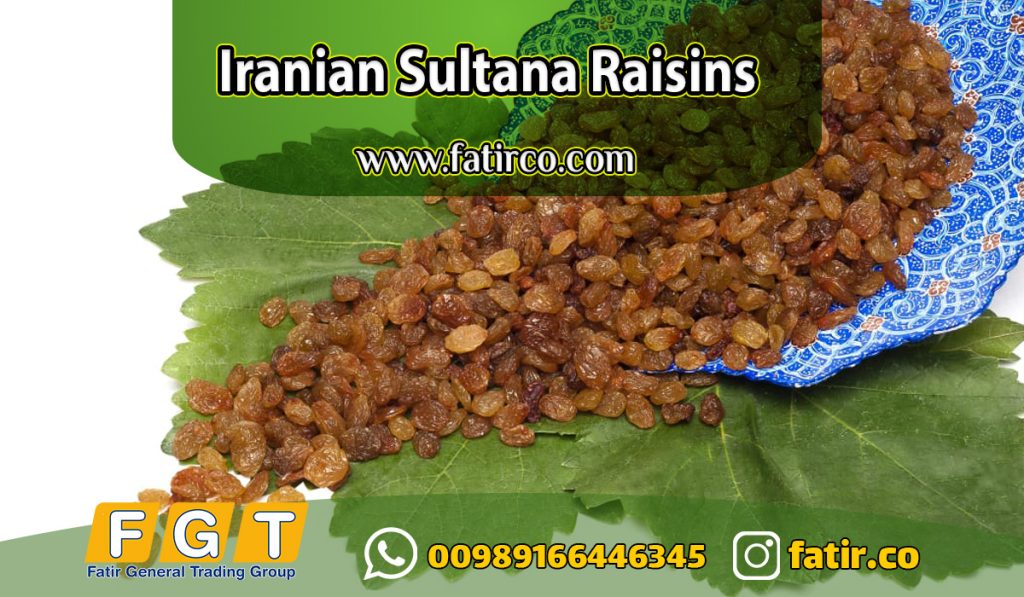
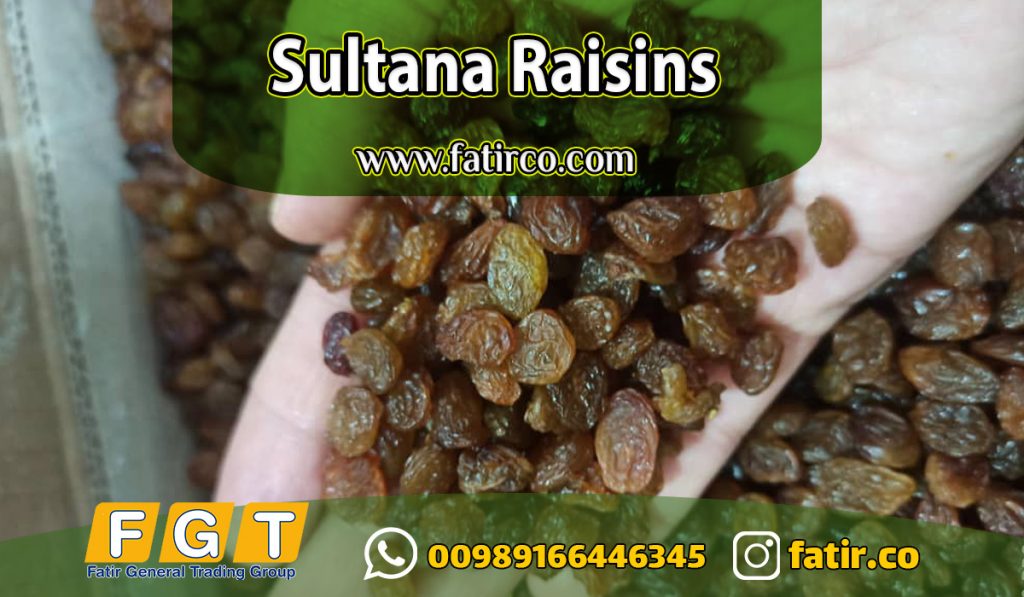
Sultana Raisins are another important export variety produced in Iran. They are made from seedless grapes and are recognized for their light to dark brown color, tender texture, and rich sweetness.
Because of their high natural sugar content, Sultana raisins are widely used by the food industry.
Main Characteristics
- Light brown to dark brown color
- Soft texture
- High natural sweetness
- Excellent baking performance
- Good moisture balance
Common Applications
- Bread production
- Cakes
- Muffins
- Pastries
- Breakfast cereals
- Dairy products
Their excellent processing performance makes them one of the preferred choices for industrial food manufacturers.
Sun-Dried Raisins
Sun-Dried Raisins represent one of the most natural forms of dried grapes. As the name suggests, they are dried naturally under sunlight without artificial coloring, resulting in a darker appearance and a rich, caramel-like flavor profile.
Many consumers prefer this variety because it is produced with minimal processing while maintaining the grapes’ natural characteristics.
Main Characteristics
- Dark brown color
- Rich natural sweetness
- Chewy texture
- No artificial coloring
- Traditional drying process
Common Applications
- Healthy snacks
- Energy bars
- Granola
- Traditional recipes
- Home baking
- Organic food products
Sun-Dried Raisins are particularly appreciated in markets where consumers prefer naturally processed foods.
Green Raisins
Green Raisins are one of Iran’s most distinctive specialty products. Produced mainly in northeastern Iran, they are recognized by their elongated shape, attractive green color, and delicate flavor.
Unlike darker raisin varieties, Green Raisins offer a lighter taste and an elegant appearance, making them popular in premium retail markets.
Main Characteristics
- Natural green color
- Long and slender shape
- Mild sweetness
- Soft texture
- Premium appearance
Common Applications
- Premium snack packs
- Gift boxes
- Traditional cuisine
- Rice dishes
- Gourmet food stores
- Luxury retail packaging
Because of their unique appearance, Green Raisins often command higher prices in specialty markets.
Black Raisins
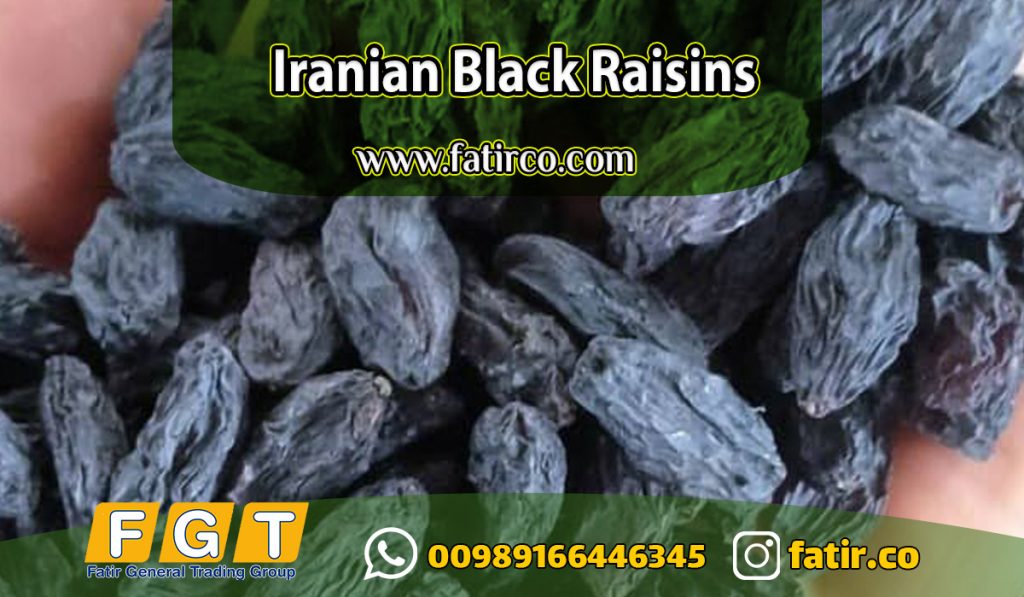
Black Raisins are produced by naturally drying dark-colored grapes. They are known for their deep color, intense sweetness, and high antioxidant content.
Their rich flavor makes them suitable for both direct consumption and food manufacturing.
Main Characteristics
- Dark purple to black color
- Rich fruity flavor
- Soft texture
- Naturally sweet
- High antioxidant content
Common Applications
- Healthy snacks
- Traditional desserts
- Bakery products
- Trail mixes
- Nutritional food products
Black Raisins continue to gain popularity among consumers looking for minimally processed, nutrient-rich dried fruits.
Choosing the Right Raisin for Your Business
Selecting the right raisin variety depends on several factors, including the target market, product application, customer preferences, and packaging requirements.
For example:
| Raisin Type | Best Applications |
|---|---|
| Golden Raisins | Retail, cereals, bakery, snacks |
| Sultana Raisins | Baking, dairy, confectionery |
| Sun-Dried Raisins | Organic foods, healthy snacks |
| Green Raisins | Premium retail, gourmet products |
| Black Raisins | Functional foods, desserts, snack industry |
Understanding these differences enables importers to choose products that match consumer demand while optimizing product quality and profitability.
Why International Buyers Choose Iranian Raisins
The diversity of Iranian raisins provides buyers with exceptional flexibility. Instead of sourcing different products from multiple countries, importers can often obtain a complete portfolio of raisin varieties from a single reliable supplier in Iran.
Combined with modern processing facilities, competitive pricing, flexible packaging options, and consistent export quality, this diversity has helped Iranian raisins earn a strong reputation in global markets.

Golden Raisins – Iran’s Most Popular Export Raisin
Among all varieties of Iranian raisins, Golden Raisins have established themselves as one of the most demanded products in international trade. Their bright golden color, naturally sweet taste, soft texture, and attractive appearance make them a preferred choice for wholesalers, food manufacturers, retailers, and private-label brands around the world.
Iran has become one of the leading suppliers of premium golden raisins thanks to its ideal grape-growing conditions, modern processing facilities, and decades of export experience. Today, Iranian Golden Raisins are shipped to customers across Europe, the Middle East, Asia, Africa, and many other international markets.
What Makes Iranian Golden Raisins Special?
Unlike ordinary raisins, Golden Raisins are carefully processed to achieve a uniform golden-yellow color while preserving their natural sweetness and soft texture.
The production begins with carefully selected seedless grapes harvested at optimal maturity. Only healthy grapes with appropriate sugar content are chosen to ensure consistent product quality.
After harvesting, the grapes undergo controlled drying and processing under carefully monitored conditions. Once drying is complete, the raisins are transferred to modern processing facilities where they are cleaned, sorted, graded, and prepared for export.
This combination of high-quality raw materials and advanced processing technology results in raisins that meet the demanding requirements of international buyers.
Appearance and Physical Characteristics
Premium Iranian Golden Raisins are recognized for their attractive and uniform appearance.
Typical characteristics include:
- Bright golden-yellow color
- Uniform size
- Soft and chewy texture
- Pleasant natural sweetness
- Clean surface
- Minimal stem content
- Excellent visual consistency
These qualities are particularly important for retail packaging and premium food products where appearance strongly influences consumer purchasing decisions.
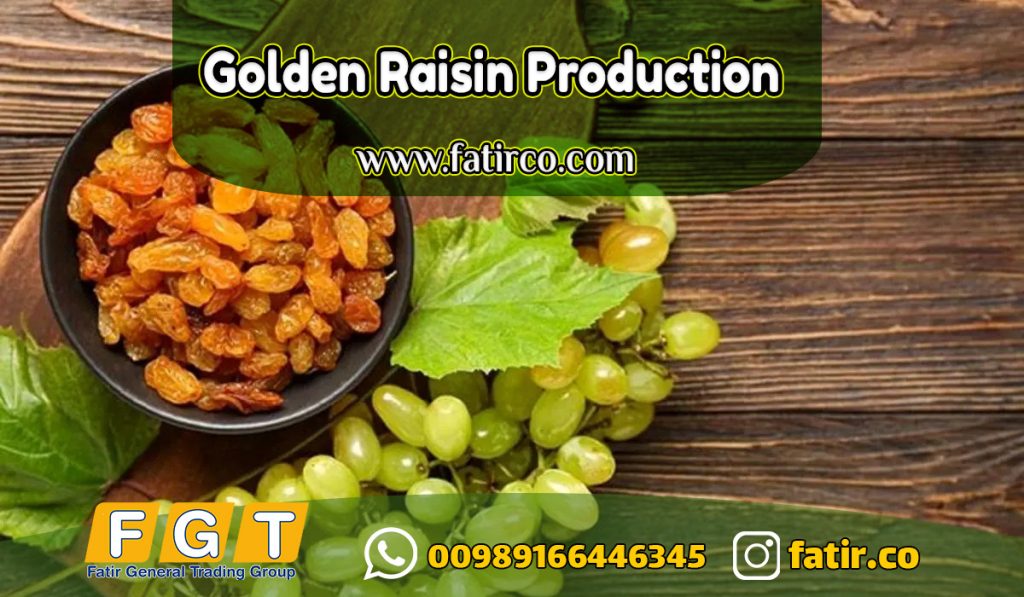
Production Process
Producing export-quality Golden Raisins involves several carefully controlled stages designed to ensure food safety, consistency, and premium quality.
The general production process includes:
- Vineyard management and grape cultivation
- Harvesting at optimum ripeness
- Initial cleaning and inspection
- Controlled drying process
- Removal of stems and foreign materials
- Washing and hygienic cleaning
- Optical color sorting
- Laser sorting for defect detection
- Metal detection
- Moisture adjustment
- Quality inspection
- Packaging for domestic or export markets
Every stage contributes to producing raisins that satisfy international food safety standards and customer specifications.
Quality Standards
International buyers expect consistency in every shipment, and reputable Iranian processors implement strict quality control systems throughout production.
Quality parameters commonly evaluated include:
- Moisture content
- Color uniformity
- Size grading
- Stem percentage
- Foreign material
- Sugar content
- Texture
- Product cleanliness
Many export facilities also apply internationally recognized food safety systems such as HACCP and ISO 22000 to support quality assurance and traceability.
Packaging Options
One of the advantages offered by Iranian exporters is flexible packaging tailored to different customer requirements.
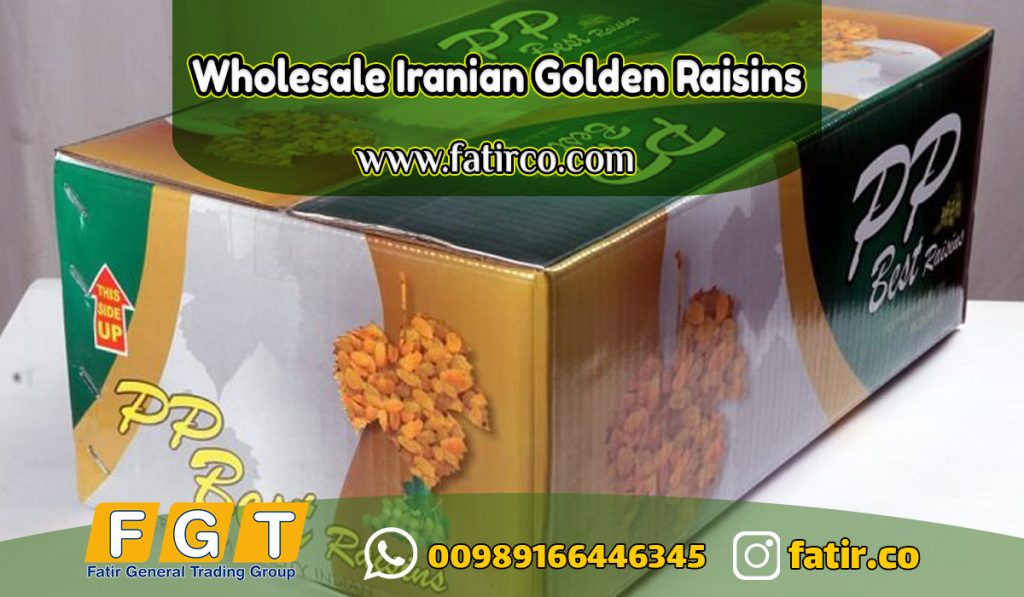
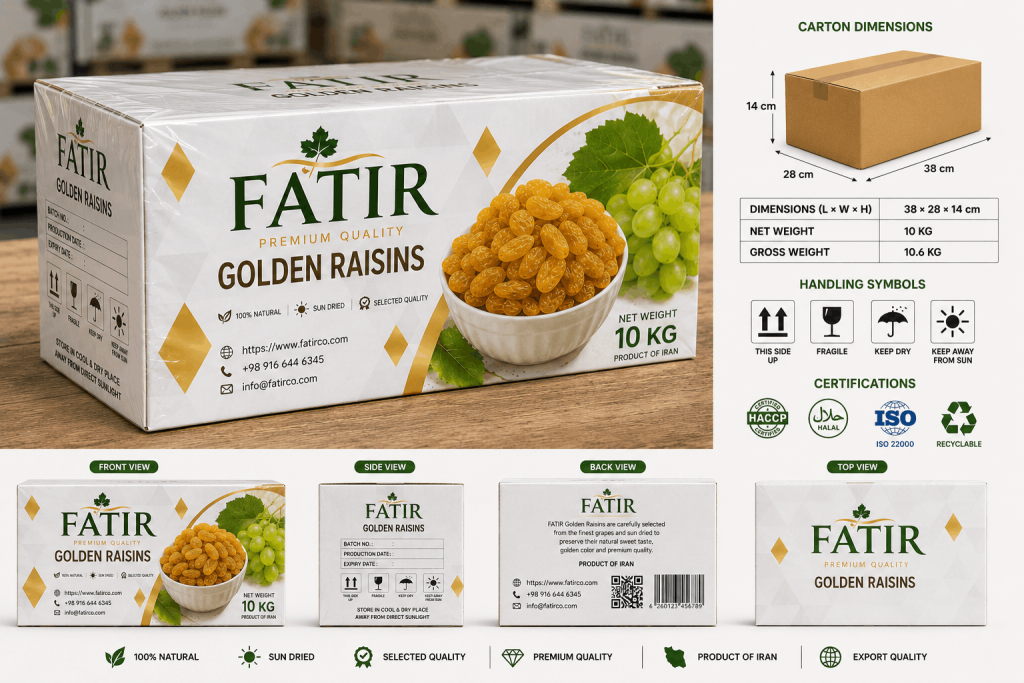
Common export packaging includes:
- 5 kg cartons
- 10 kg cartons
- 12.5 kg cartons
- Bulk bags
- Retail pouches
- Private-label packaging
Packaging materials are selected to protect product quality during transportation while meeting the specifications of wholesalers, distributors, and supermarket chains.
Applications in the Food Industry
Golden Raisins are widely used across numerous food sectors because of their appealing appearance and naturally sweet flavor.
Common applications include:
- Bakery products
- Breakfast cereals
- Cookies and biscuits
- Chocolate manufacturing
- Snack mixes
- Granola
- Dairy products
- Ice cream
- Energy bars
- Premium confectionery
Their versatility makes them one of the most valuable dried fruit ingredients for food manufacturers.
Export Markets
Iranian Golden Raisins are exported to a broad range of international markets where demand for premium dried fruits continues to grow.
Major destination markets include:
- European countries
- Gulf Cooperation Council (GCC) countries
- Southeast Asia
- Central Asia
- Africa
- Eastern Europe
Different markets may require specific packaging formats, moisture levels, quality grades, or labeling standards. Experienced Iranian exporters can often customize shipments according to customer requirements.
Why Importers Prefer Iranian Golden Raisins
International buyers choose Iranian Golden Raisins for several reasons:
- Consistent product quality
- Competitive export pricing
- Reliable year-round supply
- Modern processing facilities
- Flexible packaging solutions
- Large production capacity
- Strong export experience
- Excellent value for money
These advantages have helped Iranian suppliers build long-term business relationships with customers in many countries.
Choosing a Reliable Supplier
When sourcing Golden Raisins, buyers should evaluate more than just price.
A reliable supplier should be able to provide:
- Consistent product specifications
- Laboratory test reports when required
- Export documentation
- Food safety certifications
- Flexible packaging options
- On-time delivery
- Responsive customer service
Working with an experienced exporter reduces supply chain risks and helps ensure long-term product consistency.
Conclusion
Golden Raisins remain the flagship product of Iran’s raisin industry. Their attractive appearance, premium quality, natural sweetness, and wide range of applications make them one of the most sought-after dried fruit products in global markets.
For importers seeking dependable supply, competitive pricing, and export-quality standards, Iranian Golden Raisins continue to represent an excellent sourcing opportunity.
- Moisture measurement
- Size analysis
- Cleanliness evaluation
- Packaging inspection
- Product traceability
Many export-oriented facilities also maintain documented quality management systems to support continuous improvement.
Hygienic Packaging
Packaging is the final production stage before shipment.
Modern packaging facilities are designed to minimize contamination risks while preserving freshness and product quality.
Depending on customer requirements, raisins may be packed in:
- Food-grade cartons
- Poly-lined cartons
- Vacuum packaging
- Retail pouches
- Bulk export bags
- Private-label packaging
Proper packaging protects the product during transportation and extends shelf life under recommended storage conditions.
Storage and Export Preparation
After packaging, raisins are stored in clean, dry warehouses with controlled environmental conditions.
Maintaining appropriate temperature and humidity helps preserve:
- Product color
- Texture
- Moisture balance
- Flavor
- Shelf life
Before export, shipments are prepared according to customer specifications, including labeling, palletization, container loading, and export documentation.
From Vineyard to Global Markets
The production of Iranian raisins is a carefully managed process that combines agricultural expertise, modern technology, and rigorous quality control.
By maintaining high standards throughout cultivation, drying, processing, and packaging, Iranian producers are able to supply premium raisins that meet the expectations of wholesalers, retailers, food manufacturers, and importers around the world.
This commitment to quality has helped Iranian raisins build a strong reputation in international markets and remain one of the most competitive dried fruit products available for global trade.

Quality Standards and Export Specifications
For international buyers, product quality is more than appearance—it is a combination of consistency, food safety, cleanliness, and compliance with customer specifications. Whether raisins are intended for retail shelves, food manufacturing, or industrial processing, buyers expect every shipment to meet clearly defined quality standards.
Iranian raisin exporters understand these expectations and have invested in modern processing facilities, quality management systems, and inspection procedures to ensure that export shipments satisfy the requirements of global markets.
Product Grading
Export-quality raisins are carefully graded before packaging. The grading process helps ensure that every shipment offers consistent quality and matches the buyer’s specifications.
Typical grading criteria include:
- Color consistency
- Berry size
- Moisture level
- Texture
- Cleanliness
- Stem content
- Foreign material
- Overall appearance
Different customers may require different grades depending on their intended use. For example, premium retail brands often prefer raisins with a more uniform appearance, while industrial food manufacturers may focus primarily on functional quality and consistency.
Moisture Content
Moisture content is one of the most important quality parameters in raisin production.
Maintaining an appropriate moisture level helps preserve:
- Product freshness
- Soft texture
- Natural sweetness
- Shelf life
- Processing performance
Moisture levels are monitored throughout production to ensure that raisins remain stable during transportation and storage while meeting customer requirements.
Color Uniformity
Color is often the first quality characteristic evaluated by buyers.
Premium Iranian raisins are processed to achieve a consistent appearance that reflects the selected product grade.
Depending on the variety, raisins may range from bright golden yellow to light brown, dark brown, green, or black. Maintaining color consistency enhances product presentation and improves acceptance in international retail markets.
Size Classification
Different food applications require different raisin sizes.
For this reason, many exporters classify raisins according to size before packaging.
Uniform sizing provides several advantages:
- Better appearance
- More consistent baking performance
- Improved processing efficiency
- Higher customer satisfaction
Size grading also helps manufacturers maintain consistent product quality across multiple shipments.
Cleanliness and Foreign Material Control
Cleanliness is a critical requirement in international food trade.
Modern processing facilities use several technologies to minimize foreign materials before packaging, including:
- Air cleaning systems
- Stem removal equipment
- Optical sorting
- Density separation
- Metal detection
- Final visual inspection
These procedures help ensure that exported raisins meet strict food safety expectations and customer specifications.
Food Safety Management
Food safety is an essential part of modern raisin production.
Many export-oriented processing facilities implement internationally recognized food safety management systems that support hygienic production and product traceability.
These systems typically include:
- Good Manufacturing Practices (GMP)
- Hazard analysis and preventive controls
- Equipment sanitation
- Personnel hygiene
- Process monitoring
- Product traceability
Together, these measures help reduce risks and maintain consistent product quality throughout the production process.
Laboratory Testing
Depending on the destination market and customer requirements, exporters may conduct laboratory testing before shipment.
Testing may include verification of:
- Moisture content
- Microbiological quality
- Product cleanliness
- Physical characteristics
- Compliance with agreed specifications
Providing test reports when requested helps buyers verify product consistency and simplifies import procedures in many markets.
Packaging Integrity
Quality does not end after processing.
Proper packaging protects raisins against moisture, dust, and physical damage during transportation.
Export packaging is selected to maintain product quality throughout international shipping while complying with customer specifications and logistics requirements.
Strong cartons, food-grade inner liners, and secure palletization all contribute to safe delivery.
Traceability
Professional exporters maintain traceability systems that allow each production batch to be identified throughout the supply chain.
Traceability improves quality management by enabling producers to:
- Monitor production history
- Verify raw material sources
- Support food safety investigations if necessary
- Maintain consistent product documentation
This has become increasingly important for international buyers seeking transparency and reliable supply chains.
Meeting International Market Expectations
Every export market has its own regulatory and commercial requirements.
Experienced Iranian exporters work closely with customers to understand their specifications regarding quality, packaging, labeling, documentation, and shipping conditions.
This customer-focused approach helps ensure that products arrive ready for distribution, retail sale, or industrial processing.
A Commitment to Consistent Quality
The reputation of Iranian raisins has been built on decades of agricultural expertise combined with continuous improvements in processing technology and quality management.
By applying rigorous inspection procedures, modern processing equipment, and internationally recognized food safety practices, Iranian suppliers continue to provide raisins that meet the expectations of buyers across global markets.
For importers seeking dependable quality, consistent specifications, and professional export services, Iranian raisins remain a trusted choice.

Nutritional Value of Iranian Raisins
Raisins are much more than a naturally sweet snack. They are a concentrated source of nutrients that develop as fresh grapes are carefully dried, preserving much of their natural goodness while creating a convenient, shelf-stable food.
Iranian raisins, produced from carefully selected seedless grapes, are valued worldwide not only for their flavor and appearance but also for their nutritional profile. Their combination of natural carbohydrates, dietary fiber, vitamins, minerals, and plant-based antioxidants makes them a popular ingredient in both healthy diets and food manufacturing.
Naturally Sweet with No Added Sugar
One of the main advantages of raisins is their natural sweetness.
During the drying process, water is removed while the grapes’ naturally occurring sugars become more concentrated. As a result, raisins provide a pleasantly sweet taste without requiring added refined sugar.
This makes them an attractive ingredient for consumers seeking foods with simple, recognizable ingredients and for manufacturers developing clean-label products.
A Good Source of Dietary Fiber
Raisins naturally contain dietary fiber, an important nutrient that contributes to a balanced diet.
Fiber is valued because it can help:
- Support normal digestion
- Promote regular bowel function
- Increase feelings of fullness after meals
- Contribute to overall digestive health
For this reason, raisins are often included in breakfast cereals, snack bars, baked goods, and healthy snack mixes.
Rich in Natural Minerals
Iranian raisins also provide several naturally occurring minerals that play important roles in the body.
Depending on the grape variety and growing conditions, raisins may contain minerals such as:
- Potassium
- Iron
- Copper
- Manganese
- Magnesium
These minerals support various normal physiological functions and contribute to the overall nutritional value of raisins.
A Source of Plant-Based Antioxidants
Like fresh grapes, raisins naturally contain plant compounds with antioxidant properties.
These naturally occurring compounds help protect the fruit during growth and are retained to varying degrees after drying.
As a result, raisins are frequently included in diets that emphasize a variety of plant-based foods rich in naturally occurring bioactive compounds.
Naturally Fat-Free and Cholesterol-Free
One reason raisins are popular among health-conscious consumers is their simple nutritional profile.
Naturally produced raisins contain:
- No cholesterol
- Very little fat
- No added fat during production
This makes them suitable for a wide range of dietary patterns when consumed as part of a balanced diet.
A Convenient Source of Natural Energy
Because raisins contain naturally occurring carbohydrates, they provide a convenient source of energy.
Their portability, long shelf life, and pleasant taste make them a practical snack for:
- Students
- Office workers
- Travelers
- Outdoor enthusiasts
- Athletes seeking quick energy before or after physical activity
They are also commonly included in trail mixes and energy bars for the same reason.
Suitable for Many Food Applications
Beyond direct consumption, the nutritional value of raisins makes them a valuable ingredient in numerous food products.
Manufacturers use raisins in:
- Breakfast cereals
- Bakery products
- Granola
- Snack bars
- Dairy products
- Confectionery
- Traditional recipes
- Plant-based food products
Their natural sweetness can also help reduce the need for refined sugar in certain formulations while adding texture and flavor.
Produced from Carefully Selected Grapes
The nutritional quality of raisins begins in the vineyard.
Healthy grapes grown under favorable environmental conditions develop the natural sugars, minerals, and plant compounds that contribute to the final product.
Modern processing techniques focus on preserving product quality while maintaining food safety throughout drying, cleaning, sorting, and packaging.
An Excellent Addition to a Balanced Diet
When enjoyed in appropriate portions as part of a varied diet, Iranian raisins can be a nutritious and flavorful food choice.
Their combination of natural sweetness, dietary fiber, minerals, and plant-based compounds has made them one of the world’s most widely consumed dried fruits.
Whether eaten as a snack or incorporated into recipes, Iranian raisins offer both excellent taste and valuable nutritional benefits for consumers around the world.

Health Benefits of Iranian Raisins
For centuries, raisins have been enjoyed as a naturally sweet and nutritious food in many cultures around the world. Today, they continue to be appreciated not only for their taste but also for the valuable nutrients they provide as part of a balanced diet.
Iranian raisins, produced from carefully selected grapes, combine natural sweetness with dietary fiber, minerals, and beneficial plant compounds. When consumed in appropriate portions as part of a healthy eating pattern, they can contribute to overall nutritional intake and support a healthy lifestyle.
A Naturally Sweet Alternative
Many consumers are looking for foods with fewer highly processed ingredients and less refined sugar. Raisins offer a naturally sweet flavor without added sugars, making them a popular ingredient in recipes and snacks.
They can be enjoyed on their own or used to naturally sweeten foods such as:
- Oatmeal
- Breakfast cereals
- Yogurt
- Homemade granola
- Trail mixes
- Baked goods
Replacing part of the refined sugar in certain recipes with raisins may also add texture, flavor, and nutritional value.
Supports Digestive Health
Raisins naturally contain dietary fiber, an important component of a healthy diet.
Adequate fiber intake helps support normal digestive function and contributes to regular bowel movements. Including fiber-rich foods such as raisins alongside fruits, vegetables, whole grains, and legumes can support overall digestive health.
Provides Natural Energy
Raisins are rich in naturally occurring carbohydrates, making them a convenient source of energy.
Their compact size and long shelf life make them an ideal snack for:
- Busy professionals
- Students
- Travelers
- Hikers
- Cyclists
- Athletes before or after physical activity
Because they require no preparation, raisins are also a practical option for healthy snacking throughout the day.
Contains Beneficial Plant Compounds
Like grapes, raisins naturally contain plant-based compounds, including polyphenols.
These naturally occurring substances contribute to the overall nutritional profile of raisins and are one reason dried grapes continue to be included in many healthy eating patterns around the world.
Contributes to Mineral Intake
Raisins contain naturally occurring minerals that play important roles in normal body functions.
Depending on the variety and growing conditions, they may provide:
- Potassium
- Iron
- Copper
- Magnesium
- Manganese
These nutrients contribute to a balanced diet when consumed alongside a variety of other nutrient-rich foods.
Convenient for Healthy Snacking
Unlike many packaged snack foods, raisins require no refrigeration or preparation.
They are:
- Easy to carry
- Ready to eat
- Naturally sweet
- Suitable for lunch boxes
- Convenient for travel
- Versatile in recipes
These practical advantages have made raisins one of the world’s most widely consumed dried fruits.
Popular Among Food Manufacturers
The health-conscious food market continues to grow, increasing demand for naturally sweet ingredients.
Food manufacturers frequently incorporate Iranian raisins into:
- High-fiber cereals
- Snack bars
- Energy bites
- Bakery products
- Dairy products
- Functional food formulations
Their pleasant taste and natural sweetness help improve product appeal while supporting clean-label product development.
Enjoy Raisins as Part of a Balanced Diet
Although raisins are nutrient-dense, they are also naturally concentrated because water has been removed during drying.
For this reason, they are best enjoyed in appropriate serving sizes as part of a varied and balanced diet that includes fruits, vegetables, whole grains, lean proteins, and healthy fats.
Consumers with specific medical conditions or dietary requirements should always seek personalized advice from qualified healthcare professionals.
A Healthy Choice for Everyday Nutrition
With their natural sweetness, fiber, minerals, and versatility, Iranian raisins continue to be a popular food choice for families, athletes, food manufacturers, and health-conscious consumers worldwide.
Whether enjoyed as a quick snack or used as an ingredient in nutritious recipes, they offer a delicious way to include more naturally derived foods in everyday eating habits.

Packaging Options for Iranian Raisins
Packaging plays a crucial role in preserving the quality, freshness, and safety of raisins throughout storage and international transportation. For importers, wholesalers, retailers, and food manufacturers, selecting the right packaging solution is just as important as choosing the right product.
Professional Iranian raisin exporters understand that different markets have different packaging requirements. As a result, they offer a variety of packaging options designed to protect the product, improve logistics efficiency, and meet customer specifications.
Why Packaging Matters
High-quality packaging does more than simply contain the product. It helps maintain the raisins’ appearance, texture, and moisture while reducing the risk of contamination and physical damage during handling and shipping.
Well-designed packaging also contributes to:
- Product freshness
- Food safety
- Longer shelf life
- Easier transportation
- Efficient warehouse storage
- Better presentation at the retail level
For export shipments, packaging must also withstand long-distance transportation by sea, land, or air without compromising product quality.
Bulk Packaging for Wholesale Buyers
Bulk packaging is the most common choice for importers, distributors, and food manufacturers purchasing large volumes of raisins.
Typical bulk packaging solutions include:
- Food-grade corrugated cartons
- Poly-lined cartons
- Bulk polyethylene bags
- Large industrial bags
- Palletized export cartons
The exact packaging configuration can be customized according to customer preferences, destination market requirements, and shipping conditions.
Bulk packaging is particularly suitable for companies that further process, repack, or distribute raisins under their own brands.
Retail Packaging
For supermarkets and retail chains, raisins can also be supplied in consumer-ready packaging.
Common retail formats include:
- Stand-up pouches
- Pillow bags
- Resealable zipper bags
- Small cartons
- Plastic containers
Retail packaging is designed to provide convenience for consumers while maintaining product freshness and visual appeal.
Private Label Solutions
Many international buyers prefer to market raisins under their own brand names.
Experienced Iranian exporters can often support private label programs by providing packaging that includes the buyer’s:
- Brand name
- Logo
- Product information
- Barcode
- Nutritional labeling
- Country-specific language requirements
Private-label packaging allows distributors and retailers to strengthen their brand identity while sourcing high-quality raisins from a reliable producer.
Food-Grade Packaging Materials
Packaging materials used for export raisins should be suitable for direct food contact and selected to help protect product quality during storage and transportation.
Depending on customer requirements, packaging may include:
- Food-grade inner liners
- Moisture-resistant materials
- Strong corrugated cartons
- Protective pallet wrapping
- Secure sealing systems
These materials help minimize exposure to dust, moisture, and external contaminants during international shipping.
Customized Packaging Options
Different markets often require different packaging formats.
Many exporters can offer customized solutions based on:
- Net weight
- Carton dimensions
- Pallet configuration
- Customer branding
- Retail or industrial applications
- Shipping destination
- Container optimization
Customized packaging helps buyers improve warehouse efficiency, reduce handling costs, and better meet local market expectations.
Palletization and Container Loading
Proper palletization is an essential part of export logistics.
Well-organized pallet loading helps:
- Reduce product movement during transport
- Improve warehouse handling
- Maximize container space
- Protect packaging integrity
- Facilitate unloading at destination
Efficient container loading also contributes to lower transportation costs by making better use of available shipping space.
Labeling Requirements
Export packaging usually includes product identification and shipping information.
Depending on customer requirements and destination regulations, labels may include:
- Product name
- Country of origin
- Net weight
- Production or packing date
- Batch number
- Storage instructions
- Exporter information
Additional labeling can often be customized to comply with local import regulations.
Choosing the Right Packaging Solution
Selecting the appropriate packaging depends on several factors, including:
- Distribution channel
- Target market
- Shipping method
- Storage conditions
- Product application
- Customer preferences
An experienced exporter can help buyers determine the most suitable packaging option based on their commercial and logistical needs.
Protecting Quality from Factory to Customer
Packaging is the final step in ensuring that premium Iranian raisins arrive at their destination in excellent condition.
By combining food-grade materials, careful handling, efficient palletization, and flexible packaging solutions, Iranian exporters help preserve product quality throughout the international supply chain.
For global buyers, professional packaging provides confidence that the product received will match the quality expected when the order was placed.

Storage and Shelf Life of Iranian Raisins
Maintaining the quality of raisins after processing is just as important as producing them. Proper storage helps preserve their natural sweetness, soft texture, attractive appearance, and overall freshness throughout the supply chain.
For importers, distributors, retailers, and food manufacturers, understanding the correct storage conditions can reduce product losses, maintain customer satisfaction, and maximize shelf life.
Why Proper Storage Is Important
Although raisins are naturally shelf-stable due to their reduced moisture content, they can still be affected by unsuitable storage conditions.
Exposure to excessive heat, humidity, direct sunlight, or damaged packaging may negatively influence product quality over time.
Appropriate storage practices help preserve:
- Natural flavor
- Soft texture
- Product color
- Moisture balance
- Food safety
- Packaging integrity
Maintaining these characteristics is particularly important for export shipments that may remain in transit for several weeks before reaching their final destination.
Recommended Storage Conditions
To maintain the highest possible quality, raisins should be stored in a clean, dry, and well-ventilated environment.
General recommendations include:
- Keep the product in a cool, dry place.
- Protect it from direct sunlight.
- Avoid exposure to excessive humidity.
- Keep packages tightly sealed after opening.
- Store away from strong-smelling products to prevent odor absorption.
- Follow the storage recommendations provided by the supplier or printed on the packaging.
Consistent storage conditions help maintain the product’s quality throughout its intended shelf life.
Temperature and Humidity Considerations
Environmental conditions have a direct impact on the long-term quality of dried fruits.
High temperatures may accelerate quality deterioration, while excessive humidity can affect texture and increase the risk of moisture-related problems.
Maintaining stable storage conditions throughout warehousing and transportation helps preserve the original characteristics of the raisins.
Packaging Protection
Proper packaging serves as the first line of defense during storage.
Food-grade inner liners, strong export cartons, and secure sealing systems help protect raisins against:
- Moisture exposure
- Dust
- Physical damage
- Contamination during handling
- Transportation stress
Packaging should remain intact throughout storage and distribution to ensure product safety and quality.

Warehouse Management
Professional warehouse practices contribute significantly to maintaining raisin quality.
Recommended practices include:
- Keeping storage areas clean and organized
- Protecting products from pests
- Avoiding direct contact with the floor
- Rotating inventory using appropriate stock management systems
- Regularly inspecting packaging for damage
These practices help reduce unnecessary product losses and maintain consistent quality.
Shelf Life
When stored under suitable conditions and in appropriate packaging, raisins generally maintain their quality for an extended period.
The actual shelf life depends on several factors, including:
- Raisin variety
- Moisture content
- Packaging type
- Storage temperature
- Relative humidity
- Distribution conditions
For commercial shipments, buyers should always refer to the supplier’s product specifications, packaging information, and applicable regulatory requirements.
Transportation and Export Logistics
International transportation presents additional challenges because products may travel long distances by sea, land, or air.
To protect product quality during transit, exporters typically focus on:
- Secure packaging
- Proper palletization
- Careful container loading
- Protection from moisture
- Appropriate handling throughout the logistics chain
These measures help ensure that raisins arrive at their destination in excellent condition.
Best Practices After Opening
For retail consumers and food service operators, proper handling after opening also helps preserve quality.
Once a package has been opened:
- Reseal the package whenever possible.
- Store it in a cool and dry location.
- Use clean utensils when handling the product.
- Minimize unnecessary exposure to air and moisture.
Following these simple practices helps maintain freshness during use.
Protecting Quality from Harvest to Consumption
The journey of premium Iranian raisins does not end when production is complete.
Careful packaging, appropriate storage, efficient logistics, and proper handling throughout the supply chain all contribute to preserving the quality that buyers expect.
By following recommended storage practices, importers, distributors, retailers, and consumers can continue to enjoy the excellent taste, texture, and appearance of Iranian raisins long after they leave the processing facility.

Applications of Iranian Raisins in the Food Industry
The versatility of Iranian raisins is one of the key reasons they remain in high demand across international markets. Their natural sweetness, appealing texture, nutritional value, and long shelf life make them an essential ingredient in a wide variety of food products.
From large-scale food manufacturers to artisan bakeries and retail brands, businesses around the world use Iranian raisins to enhance both the flavor and nutritional profile of their products.
Bakery and Pastry Products
The bakery industry is one of the largest consumers of raisins worldwide.
Iranian raisins are widely incorporated into products such as:
- Bread
- Cakes
- Muffins
- Cookies
- Danish pastries
- Fruit buns
- Sweet rolls
Their natural sweetness, soft texture, and ability to retain moisture during baking make them an excellent ingredient for baked goods.
For manufacturers, raisins also provide visual appeal and a recognizable natural ingredient that consumers appreciate.
Breakfast Cereals and Granola
Breakfast cereal manufacturers frequently include raisins in ready-to-eat cereals, granola, and muesli products.
Their naturally sweet taste complements grains, oats, nuts, and seeds while adding texture and nutritional value.
Raisins are especially popular in products marketed toward consumers seeking wholesome and minimally processed ingredients.
Snack Foods
Healthy snacking continues to grow worldwide, increasing demand for naturally sweet dried fruits.
Iranian raisins are commonly used in:
- Trail mixes
- Mixed dried fruit blends
- Snack cups
- Energy bites
- School snacks
- Travel snacks
Because raisins require no preparation and have excellent shelf stability, they are convenient for both manufacturers and consumers.
Confectionery and Chocolate
The confectionery industry also uses raisins extensively.
They are incorporated into:
- Chocolate bars
- Chocolate-coated raisins
- Fruit and nut chocolates
- Candy products
- Premium confectionery
Their sweetness balances chocolate flavors while adding texture and visual contrast.
Dairy Products
Many dairy manufacturers include raisins in products designed for consumers seeking nutritious and flavorful options.
Examples include:
- Yogurt
- Breakfast parfaits
- Ice cream
- Dairy desserts
The combination of creamy dairy products with naturally sweet raisins creates products that appeal to both children and adults.
Health and Functional Foods
As demand for healthier foods continues to increase, raisins have become an important ingredient in functional food products.
Manufacturers use Iranian raisins in:
- High-fiber snacks
- Protein bars
- Energy bars
- Sports nutrition products
- Wellness snack mixes
Their natural carbohydrate content and plant-based ingredients make them suitable for many modern food formulations.
Traditional Foods Around the World
Raisins have been used in traditional cuisines for centuries.
Iranian raisins are commonly found in:
- Rice dishes
- Stuffed vegetables
- Couscous recipes
- Traditional desserts
- Festive meals
- Regional meat dishes
Their ability to complement both sweet and savory recipes makes them one of the most versatile dried fruits available.
Food Service and Hospitality
Hotels, restaurants, cafés, and catering companies regularly use raisins in menu preparation.
Typical applications include:
- Salads
- Breakfast buffets
- Desserts
- Rice dishes
- Bakery items
- Gourmet recipes
Their long shelf life and ease of storage make them practical ingredients for commercial kitchens.
Industrial Food Processing
Large-scale food manufacturers value Iranian raisins because they can be processed efficiently while maintaining consistent quality.
Industrial applications include:
- Fruit fillings
- Cereal production
- Baked snacks
- Frozen bakery products
- Ready-to-eat meals
- Ingredient blends
Reliable product specifications and consistent quality are particularly important for automated production lines.
Retail and Private Label Products
Retail brands continue to expand their range of dried fruit products.
Iranian raisins can be packaged for:
- Supermarkets
- Health food stores
- Organic food retailers
- Convenience stores
- Online marketplaces
Many international buyers also develop private-label raisin products tailored to local consumer preferences.
A Versatile Ingredient for Global Food Industries
The broad range of applications demonstrates why Iranian raisins remain one of the world’s most valuable dried fruit products.
Their excellent flavor, consistent quality, attractive appearance, and flexible packaging options allow them to serve the needs of multiple industries simultaneously.
Whether used in bakery production, breakfast foods, confectionery, dairy products, snack manufacturing, or traditional cuisine, Iranian raisins continue to provide a dependable ingredient for businesses seeking premium quality and reliable supply.

Global Export Markets for Iranian Raisins
Iranian raisins have earned a strong reputation in international markets due to their premium quality, competitive pricing, diverse product range, and reliable supply capacity. Over the years, Iranian exporters have built long-term business relationships with importers, distributors, food manufacturers, and retail brands across multiple continents.
International trade trends for dried fruits are also monitored by organizations such as the International Nut and Dried Fruit Council (INC).
As global demand for naturally sweet and nutritious dried fruits continues to grow, Iranian raisins remain an attractive sourcing option for businesses seeking consistent quality and flexible export solutions.
Serving Customers Around the World
Today, Iranian raisins are supplied to customers in numerous international markets. Different regions often have unique preferences regarding raisin varieties, packaging formats, labeling, and product specifications.
Experienced exporters understand these differences and can tailor products to meet the specific requirements of each market.
European Markets
European buyers generally place a strong emphasis on:
- Consistent product quality
- Food safety
- Product traceability
- Hygienic processing
- Reliable documentation
- Attractive retail packaging
Golden Raisins and Sultana Raisins are particularly popular for bakery products, breakfast cereals, confectionery, and retail dried fruit categories.
Many European importers also value suppliers who can provide customized packaging and long-term supply programs.
Middle East and Gulf Countries
The Middle East remains one of the most important destinations for Iranian raisins due to geographical proximity, established trade relationships, and strong consumer demand.
Customers in this region often purchase raisins for:
- Retail distribution
- Traditional foods
- Hospitality businesses
- Confectionery
- Food processing
Flexible packaging options and reliable delivery schedules are particularly important for buyers in these markets.
Asian Markets
Asia represents one of the fastest-growing markets for dried fruits.
Food manufacturers throughout the region increasingly use raisins in:
- Bakery production
- Snack manufacturing
- Dairy products
- Breakfast cereals
- Functional foods
Growing consumer interest in healthier eating habits has further increased demand for naturally sweet ingredients such as raisins.
African Markets
Many African countries continue to experience increasing demand for imported food products.
Iranian raisins are appreciated because they combine:
- Good quality
- Competitive prices
- Flexible order quantities
- Reliable availability
These advantages make them suitable for wholesalers, distributors, and food manufacturers operating in developing markets.
Food Manufacturers Worldwide
In addition to geographical markets, Iranian raisins are supplied to businesses operating across numerous food sectors.
Typical buyers include:
- Bakery manufacturers
- Breakfast cereal producers
- Chocolate manufacturers
- Dairy companies
- Snack food producers
- Ingredient distributors
- Food service suppliers
These customers often require consistent specifications across multiple shipments, making quality control and reliable production capacity essential.
Flexible Export Solutions
Every international buyer has unique requirements.
Professional Iranian exporters can often customize shipments based on:
- Raisin variety
- Product grade
- Packaging format
- Private-label requirements
- Container quantity
- Shipping schedule
- Destination regulations
This flexibility allows buyers to source products that match both market demand and operational requirements.
Reliable Supply Chain
One of the major strengths of Iran’s raisin industry is its ability to maintain stable production across multiple agricultural regions.
Combined with modern processing facilities and experienced exporters, this enables suppliers to support both seasonal purchases and long-term supply agreements.
Reliable production capacity also helps minimize supply interruptions during international trade.
Why International Buyers Choose Iranian Raisins
Importers continue to source raisins from Iran because they offer an attractive combination of:
- Premium product quality
- Competitive export pricing
- Wide product selection
- Modern processing technology
- Flexible packaging options
- Professional export experience
- Reliable production capacity
These advantages have positioned Iranian raisins as a trusted choice in many global markets.
Building Long-Term Business Partnerships
Successful international trade is based on more than competitive pricing.
Professional exporters focus on building lasting relationships through:
- Consistent product quality
- Transparent communication
- On-time deliveries
- Responsive customer support
- Customized solutions
- Long-term reliability
For buyers seeking a dependable sourcing partner, these qualities are often just as valuable as the product itself.
Meeting the Needs of Global Buyers
As consumer demand for premium dried fruits continues to expand, Iranian raisins remain well positioned to serve international markets.
Whether supplying wholesalers, supermarket chains, food manufacturers, or private-label brands, Iranian exporters continue to deliver products that combine quality, value, and flexibility.
Their ability to adapt to different market requirements has made Iranian raisins one of the most competitive dried fruit products available in global trade.

Why Choose an Iranian Raisin Supplier
Choosing the right supplier is one of the most important decisions for any importer, wholesaler, or food manufacturer. Beyond product quality, buyers need a reliable business partner who can consistently meet specifications, ensure timely deliveries, and support long-term commercial relationships.
Iran has become one of the world’s most respected sources of premium raisins, not only because of its favorable agricultural conditions but also because of the professionalism of its export-oriented producers and processors.
Working with an experienced Iranian raisin supplier offers numerous advantages for international buyers.
Modern food production practices are increasingly aligned with internationally recognized agricultural recommendations published by the Food and Agriculture Organization (FAO).
Consistent Product Quality
Consistency is essential in international trade.
Whether supplying supermarkets, food manufacturers, or industrial processors, buyers expect every shipment to match previously approved specifications.
Professional Iranian suppliers implement strict quality control procedures throughout:
- Grape selection
- Drying
- Processing
- Sorting
- Packaging
- Final inspection
This systematic approach helps maintain uniform quality from one shipment to the next. Many food manufacturers also implement quality systems based on ISO food safety management standards.
Wide Selection of Raisin Varieties
One of Iran’s greatest advantages is the diversity of raisins available.
Buyers can source multiple products from a single supplier, including:
- Golden Raisins
- Sultana Raisins
- Sun-Dried Raisins
- Green Raisins
- Black Raisins
Working with one supplier for multiple varieties simplifies procurement, logistics, and inventory management.
Modern Processing Facilities
Export-oriented raisin processors continue to invest in advanced production technology.
Many facilities utilize equipment for:
- Optical sorting
- Laser sorting
- Washing and cleaning
- Stem removal
- Metal detection
- Hygienic packaging
These technologies help improve product consistency while supporting international food safety expectations.
Flexible Packaging Solutions
Every buyer has different packaging requirements.
Professional suppliers often provide flexible solutions for:
- Bulk industrial packaging
- Wholesale cartons
- Retail consumer packs
- Private-label products
- Customized labeling
- Customer-specific packaging formats
This flexibility enables buyers to better serve their local markets.
Reliable Export Experience
International trade requires much more than manufacturing high-quality products.
Experienced exporters understand the importance of:
- Accurate documentation
- Export procedures
- Shipping coordination
- Customer communication
- Production scheduling
- Timely order fulfillment
A supplier with export experience can significantly reduce delays and logistical challenges.
Stable Production Capacity
One of the major concerns for importers is the ability of a supplier to fulfill repeat orders consistently.
Iran’s extensive vineyard network and modern processing industry enable many exporters to support:
- Long-term contracts
- Seasonal purchasing programs
- Large-volume orders
- Regular container shipments
Reliable production capacity helps buyers plan their inventory with greater confidence.
Competitive Value
Price is an important consideration, but long-term value depends on much more than the lowest quotation.
Professional buyers evaluate suppliers based on:
- Product consistency
- Service quality
- Reliability
- Packaging standards
- Delivery performance
- Communication
A dependable supplier often reduces overall purchasing costs by minimizing quality issues and supply interruptions.
Customer-Focused Service
Strong business relationships are built on communication and responsiveness.
Experienced suppliers work closely with buyers to understand their requirements and provide solutions tailored to their business.
Support may include:
- Product recommendations
- Packaging advice
- Technical documentation
- Sample preparation
- Order tracking
- After-sales communication
This collaborative approach contributes to long-term partnerships rather than one-time transactions.
Commitment to International Standards
Global buyers increasingly expect suppliers to demonstrate professionalism throughout the supply chain.
Many Iranian exporters continue to improve their operations by adopting internationally recognized quality management and food safety practices, investing in modern equipment, and strengthening traceability systems.
This ongoing commitment enhances buyer confidence and supports long-term cooperation.
Building Long-Term Partnerships
Successful international trade is based on trust, transparency, and consistency.
The most successful supplier relationships are those that create value for both parties over many years.
By combining premium-quality raisins, flexible production capabilities, reliable logistics, and responsive customer service, experienced Iranian suppliers continue to strengthen their position in global markets.
For importers seeking a dependable business partner, Iran remains one of the most attractive sourcing destinations for premium raisins.

Why Partner with Fatirco?
At Fatirco, we understand that every customer has unique business requirements. Our goal is not simply to supply raisins, but to build long-term partnerships based on trust, quality, and reliability.
We are committed to providing:
- Carefully selected premium Iranian raisins
- Consistent export quality
- Flexible packaging solutions
- Customized private-label options
- Reliable international shipping support
- Professional communication throughout the purchasing process
Whether you are an importer, wholesaler, distributor, or food manufacturer, our team is dedicated to helping you source high-quality Iranian raisins that meet your market’s expectations.
We welcome inquiries from businesses around the world and look forward to building successful, long-term partnerships.

Frequently Asked Questions (FAQ)
1. Why are Iranian raisins popular in international markets?
Iranian raisins are widely recognized for their excellent quality, natural sweetness, competitive pricing, and wide range of varieties. Combined with modern processing facilities and reliable export capabilities, these advantages have made Iran one of the leading suppliers of raisins to global markets.
2. What types of raisins are produced in Iran?
Iran produces several popular raisin varieties, including:
- Golden Raisins
- Sultana Raisins
- Sun-Dried Raisins
- Green Raisins
- Black Raisins
Each variety offers unique characteristics suitable for different food applications and consumer preferences.
3. Are Iranian raisins seedless?
Most export-quality Iranian raisins are produced from seedless grape varieties. However, the exact product specification depends on the selected raisin type and customer requirements.
4. What industries use Iranian raisins?
Iranian raisins are widely used in:
- Bakery products
- Breakfast cereals
- Snack foods
- Chocolate and confectionery
- Dairy products
- Food manufacturing
- Hospitality and food service
- Retail packaged foods
Their versatility makes them an important ingredient in numerous food sectors.
5. How should raisins be stored?
Raisins should be stored in a cool, dry place away from direct sunlight and excessive humidity. Keeping packages properly sealed helps maintain product freshness and quality throughout storage.
6. Can Iranian raisins be supplied in bulk?
Yes. Many exporters offer bulk packaging suitable for wholesalers, food manufacturers, and industrial buyers. Packaging options may also be customized according to customer requirements.
7. Is private-label packaging available?
Many professional exporters provide private-label packaging services, allowing customers to market Iranian raisins under their own brand names with customized packaging and labeling.
8. What should buyers consider when selecting a raisin supplier?
Buyers should evaluate suppliers based on several factors, including product quality, processing standards, packaging options, export experience, production capacity, communication, and reliability.
9. Are Iranian raisins suitable for healthy diets?
When consumed as part of a balanced diet, raisins provide naturally occurring carbohydrates, dietary fiber, minerals, and plant-based compounds. They are widely enjoyed as a naturally sweet snack and as an ingredient in many nutritious food products.
10. Which countries import Iranian raisins?
Iranian raisins are exported to numerous countries across Europe, Asia, the Middle East, Africa, and other international markets. The specific destination markets may vary depending on customer demand, product specifications, and trade conditions.
11. What packaging options are available for export?
Export packaging can include bulk cartons, food-grade lined boxes, retail pouches, and customized private-label solutions. The packaging format is typically selected based on the buyer’s requirements and intended market.
12. Why choose Iranian raisins over other origins?
Iranian raisins offer an excellent combination of premium quality, diverse product varieties, competitive pricing, reliable production capacity, and extensive export experience. These strengths make them an attractive choice for importers seeking dependable long-term suppliers.

Conclusion
Iran has established itself as one of the world’s leading producers and exporters of premium raisins. Supported by favorable growing conditions, centuries of viticulture experience, and continuous investment in modern processing technologies, the country offers a diverse range of high-quality raisins that meet the needs of international markets.
From Golden Raisins and Sultana Raisins to Green Raisins, Black Raisins, and Sun-Dried Raisins, Iranian producers supply products that combine natural sweetness, attractive appearance, nutritional value, and reliable quality. These raisins are widely used in bakery products, breakfast cereals, confectionery, dairy products, healthy snacks, and many other food applications.
Beyond product quality, Iranian exporters provide the flexibility required by today’s global buyers. Customized packaging, private-label solutions, consistent production capacity, and professional export services enable importers, wholesalers, distributors, and food manufacturers to source raisins that match their commercial requirements and market expectations.
As global demand for naturally produced, nutritious dried fruits continues to grow, Iranian raisins remain a trusted choice for businesses seeking dependable supply, competitive value, and long-term partnerships. Their proven reputation in international trade reflects the combination of agricultural expertise, modern processing standards, and a commitment to continuous quality improvement.
For companies looking to build reliable supply chains, selecting the right export partner is just as important as selecting the right product. Working with an experienced supplier helps ensure consistent quality, efficient logistics, transparent communication, and solutions tailored to specific business needs.
At Fatirco, we are committed to delivering premium Iranian raisins that meet international quality standards while supporting our customers with responsive service, flexible packaging options, and dependable export solutions. Whether you are an importer, wholesaler, retailer, or food manufacturer, we are ready to help you source high-quality raisins from Iran with confidence.
Food safety requirements in international trade are commonly supported by the Codex Alimentarius food standards.
If you are looking for a reliable supplier of premium Iranian raisins, our team welcomes your inquiries and is ready to assist you with product information, packaging options, and export solutions tailored to your market. For pricing, product specifications, or export inquiries, please contact our team. To learn more about our company, experience, and export services, visit our About Us page.

